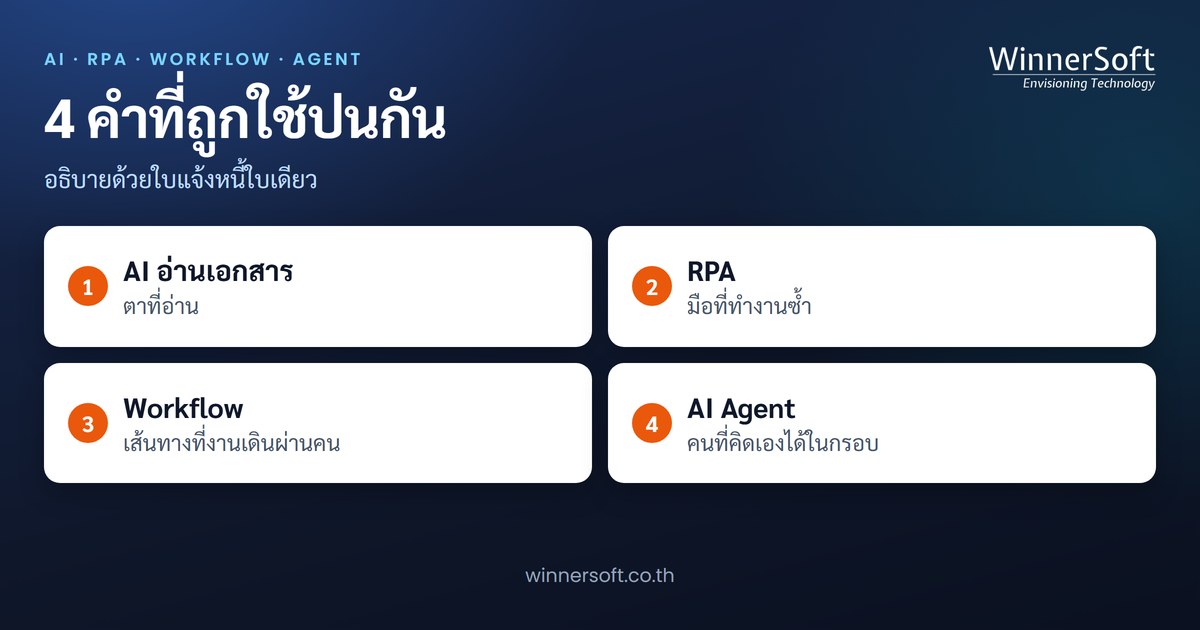
In automation meetings these four terms get swapped for one another as though they were the same thing. That is usually where the budget starts flowing in the wrong direction.
The expensive mistake is not picking the wrong vendor. It is picking the wrong category of tool. An organisation that needs hands and buys a route ends up with a system that works perfectly at everything except the problem it was bought to solve.
The clearest way to separate them is to walk one job end to end.
The example: an invoice arrives and has to be paid
Almost every organisation has this process, and it genuinely needs all four if you want it to finish without anyone re-typing anything.
Document AI is the eyes
Its job is turning paper into data: who sent it, what the total is, when it falls due, whether tax is a separate line or already included.
What separates modern document AI from older OCR is that OCR can tell you which characters sit at which coordinates but not which number is the total. Modern systems work from meaning rather than position, so a layout they have never seen before still reads correctly with no template built in advance.
What it does not do: anything with the data afterwards. It extracts, and then it is finished.
RPA is the hands
RPA takes that data and keys it into the ERP, matches it against the purchase order, files the attachment and updates the tracking sheet.
What separates RPA from writing an integration is that it drives the screen the way a person does — click, type, copy. No changes to the existing system, no API required, no database access. A legacy system nobody has dared touch in ten years works with a bot perfectly well.
What it does not do: decide. If the rules do not cover the situation, it stops or it gets it wrong.
Workflow is the route
Workflow governs the order in which people decide. Send it to the manager. Over the limit, escalate to the director. No answer in three days, remind. Approver on leave, delegate. And afterwards, show who approved what, when, and why.
RPA cannot substitute here, because the problem is not repetition. The problem is waiting on people.
What it does not do: enter data. Organisations that deploy workflow alone tend to end up with an elegant approval system whose final step is still a person typing into the ERP.
An AI Agent thinks within a boundary
Say the invoice reads 98,000 and the purchase order says 100,000. RPA stops, because the rule does not match. An agent goes looking for the reason — a short delivery, or a contracted price adjustment — and proposes options for a person to decide on.
The real distinction: RPA follows rules written in advance, an agent is given a goal and works out the method. That makes it valuable exactly where situations are unpredictable, and risky exactly where you need the same outcome every single time.
RPA follows the rule. An agent finds a way. Each one's strength is the other's weakness.
The short version
- Document AI — the eyes and the reading brain
- RPA — the hands that repeat
- Workflow — the route work takes through people
- AI Agent — judgement inside a defined boundary
One question that settles it
Ask where the work is actually stuck.
- Stuck because someone reads a document and re-types it → start with document AI
- Stuck because someone repeats the same steps daily → start with RPA
- Stuck waiting on approval, with nobody able to say where → start with Workflow
- Stuck because every case differs too much to write rules for → only then consider an agent
In practice most organisations are stuck on the first two at once, which is why document AI and RPA are so often deployed together: one turns paper into data, the other carries the data to where it needs to land.
The most expensive mistake
Starting with a tool and then looking for work to give it.
Most failed projects did not fail on technology. They failed because the wrong process was chosen on day one — something run once a month, something whose steps are still changing, or something already broken upstream. Any of those three makes every tool look like poor value, whichever category you picked.
Where to start
If you are not sure which of the four your organisation is stuck on, take the one process people complain about most and measure where the time actually goes. The answer is usually not the one everybody assumed.
WinnerSoft works across all three tools — LuminexDoc for documents, Nintex RPA for repetitive work, Nintex K2 for approval processes — so we have no reason to push one at you. Talk to us about which one your process should start with.