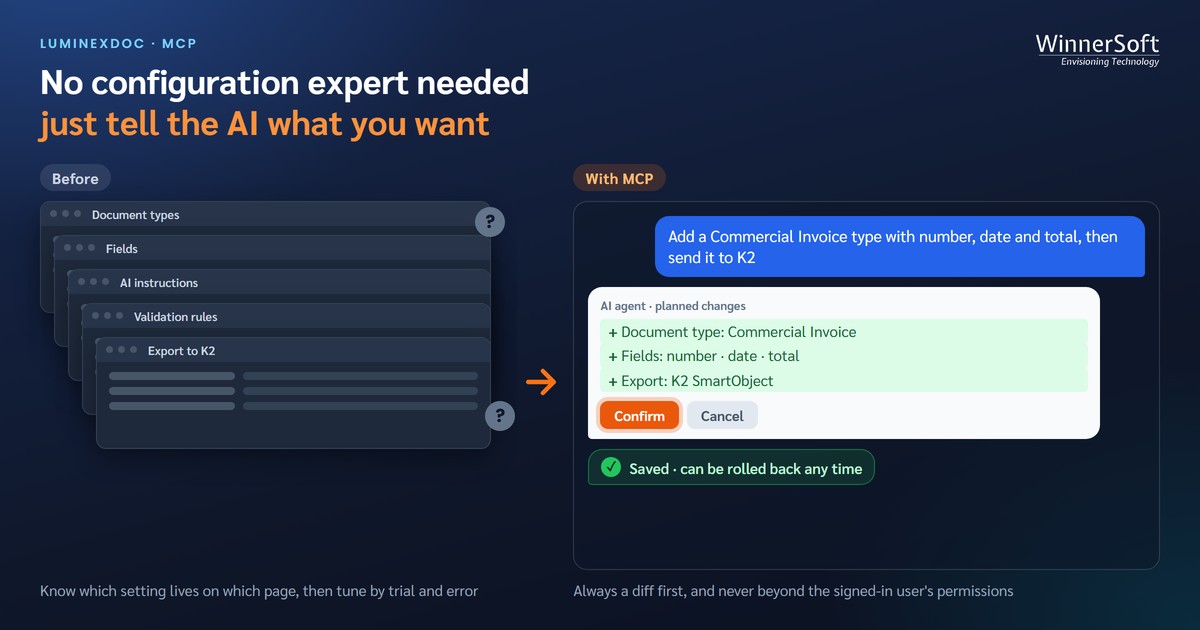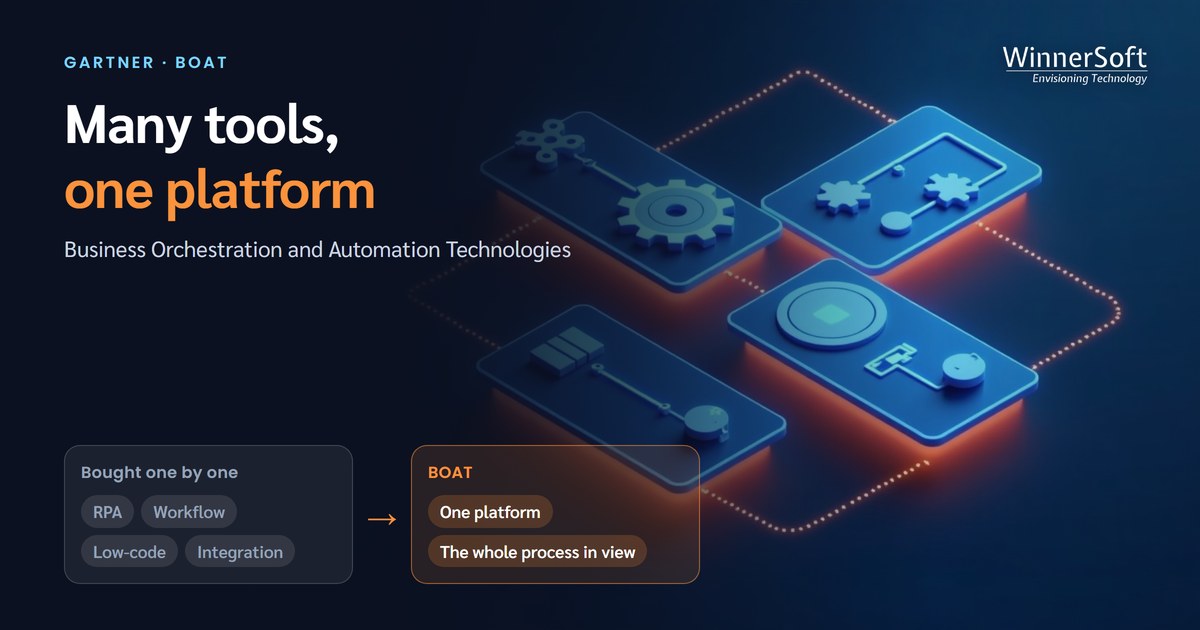
Intelligent Document Processing (IDP) is software that uses AI to read documents, work out what each piece of information means, turn it into structured data, check it and send it to business systems. OCR only converts an image to text. IDP suits organizations that receive large volumes of invoices, contracts or forms in many formats.
For Thai organizations this affects daily work directly. Much business information still arrives as paper, scanned PDFs, email attachments and photos, and PDPA means organizations must be able to show how personal data in those documents is handled. IDP reduces repeated keying, sends only uncertain items to people, and keeps a processing history for later review. Results vary by document and process, so they should be measured on your own documents.
IDP vs Traditional OCR: Understanding the Critical Differences
Many organizations assume that OCR (Optical Character Recognition) and IDP are the same thing. They are not. OCR is a component of IDP — the part that reads characters from an image — but IDP goes far beyond character recognition. Understanding the difference is essential for making the right technology investment. Here are the six critical areas where IDP and traditional OCR diverge:
| Point | OCR | IDP |
|---|---|---|
| Output | Text from an image | The fields you need, with check results |
| New document formats | Often needs another template or rule | Reads from context, without a template for every layout |
| Unstructured documents | Gives text, not meaning | Extracts by meaning, such as parties and key dates |
| Uncertain values | May return a wrong value without warning | Can send them to a person |
| Best fit | Making documents searchable | High-volume work that feeds business systems |
- Accuracy: OCR reads clean printed text well, but results often fall on poor scans, stamps or handwriting, and it cannot tell you which values may be wrong. IDP platforms use context when reading, and some cross-check several AI models and send uncertain fields to a person.
- Template requirements: Traditional OCR requires pre-defined templates for each document layout. When a new vendor sends an invoice with a different format, the template must be manually created before the system can process it. IDP uses AI to understand document structure dynamically — it can process a new invoice format it has never seen before by recognizing contextual patterns like 'Total Amount,' 'Due Date,' and 'Invoice Number' regardless of where they appear on the page.
- Language support: Most OCR engines were built for Latin-script languages and struggle with Thai, Chinese, Japanese, and other complex scripts. Thai characters with their tone marks, vowel placements above and below the consonant line, and lack of spaces between words present particular challenges. IDP platforms with proper Thai language training handle these complexities natively, understanding not just individual characters but complete Thai phrases, addresses, and names.
- Improvement: template-based OCR needs its templates or rules edited when a format changes. IDP can usually be adjusted through human corrections, instructions or configuration. The method and the result vary by product, so ask vendors exactly how corrections are used.
- Unstructured document handling: OCR is designed for structured or semi-structured documents with predictable layouts. When faced with truly unstructured content — a handwritten note, a free-form email, a legal contract with variable clauses — OCR fails. IDP leverages natural language understanding to extract meaningful data from unstructured documents, identifying key entities, dates, monetary amounts, and relationships even in free-text paragraphs.
- Cost: OCR often starts cheaper, but you still pay for error correction, template upkeep and the staff time spent on documents outside supported formats. IDP may cost more at the start, so judge value from your measured volume and time, not the per-page price alone.
How IDP Works: The 4-Step Process
Step 1 — Document Ingestion: The IDP process begins when documents enter the system. Unlike traditional OCR that requires pre-sorted, pre-classified document batches, modern IDP platforms accept documents from virtually any source and in any format. Documents can arrive via email attachments, scanned paper, uploaded PDFs, photographs taken on mobile devices, or direct feeds from ERP and accounting systems. The ingestion layer automatically classifies each document — determining whether it is an invoice, a contract, a receipt, a government form, or another document type — and routes it to the appropriate extraction pipeline. Advanced IDP systems handle mixed-language documents seamlessly, recognizing that a single invoice might contain Thai company names, English product descriptions, and numerical data in various formats.
Step 2 — AI-Powered Extraction: Once a document is classified, multiple AI models work simultaneously to extract data. Computer vision models identify the document layout, locate text regions, tables, signatures, stamps, and logos. OCR engines convert image-based text to machine-readable characters. Natural language processing models understand the meaning and context of the extracted text — distinguishing between a shipping address and a billing address, recognizing that 'ยอดรวมทั้งสิ้น' means total amount, or identifying that a date written as '16 มี.ค. 2569' corresponds to March 16, 2026 in the Buddhist calendar. Machine learning models trained on thousands of similar documents predict the most likely correct values for each field, even when the source document is partially obscured, poorly scanned, or handwritten.
Step 3 — Multi-AI Consensus Validation: Some platforms add this layer of checking. Rather than relying on a single extraction result, they employ a consensus validation approach where multiple AI models independently process the same document and then compare their results. When all models agree on an extracted value, confidence is high and the result is accepted automatically. When models disagree — perhaps one reads a digit as '6' while another reads it as '8' — the system flags the discrepancy for review. This 3-way AI verification process dramatically reduces the false-positive problem that plagues traditional OCR, where the system confidently returns an incorrect value. The consensus approach means that only genuinely ambiguous cases require human attention.
Step 4 — Structured Output and Integration: The final step transforms validated extraction results into structured data that flows directly into downstream business systems. Extracted invoice data populates accounting software with correct vendor names, amounts, tax calculations, and line items. Contract data feeds into contract management systems with key dates, parties, obligations, and renewal terms. KYC document data integrates with compliance platforms for identity verification. The output format is configurable — JSON, XML, CSV, or direct API calls to systems like SAP, Oracle, Microsoft Dynamics, or custom Thai ERP platforms. Crucially, every extraction includes a complete audit trail showing what was extracted, which AI models processed the document, confidence scores for each field, and any human corrections made — providing the documentation trail that PDPA compliance and internal audit teams require.
Real-World Use Cases for IDP in Thai Organizations
- Invoice processing and accounts payable: companies that receive many supplier invoices in Thai and English use IDP to extract vendor names, tax IDs, line items, quantities, unit prices, VAT and payment terms, then match them against purchase orders in the ERP system. A measured example: in one process at a Japanese automotive parts manufacturer in Thailand, LuminexDoc cut the human time per document by 70%, from 5.76 to 1.75 minutes.
- Contract data extraction and management: Legal and procurement teams spend enormous time manually reviewing contracts to extract key terms — renewal dates, payment schedules, penalty clauses, SLA commitments, and termination conditions. IDP reads contracts in Thai and English, identifies and extracts these critical data points, and populates contract management databases automatically. This enables proactive contract management — alerting teams to upcoming renewals or expiring terms before deadlines pass.
- KYC document verification for financial services: Thai banks, insurance companies, and fintech firms are required to verify customer identities through document checks — national ID cards, house registration documents, company registration certificates, and bank statements. IDP extracts and cross-references data across multiple identity documents, flags inconsistencies, and verifies that required fields are present and valid. This reduces repeated document checks during onboarding, while the final decision still follows the organization's regulatory rules.
- Insurance claims processing: Insurance companies in Thailand receive claims documentation in every imaginable format — hospital bills with handwritten notes, police reports, photographs of damage, repair estimates, and receipts. IDP processes this heterogeneous mix of documents, extracting claim-relevant data and automatically routing claims based on type, amount, and complexity. Straightforward claims move through faster, while complex cases are flagged for adjuster review with all relevant data pre-extracted and organized.
- Government and regulatory document processing: Thai government agencies and companies that interact heavily with government departments deal with standardized but complex document formats — tax filings, customs declarations, BOI applications, regulatory reports, and official correspondence. These documents often use specific Thai government terminology and formatting conventions. IDP trained on Thai government document formats can extract and validate data from these forms with high accuracy, reducing processing backlogs and improving compliance with filing deadlines.
- Medical records and healthcare documentation: Hospitals and clinics generate massive volumes of documentation — patient intake forms, lab results, prescription records, referral letters, and insurance claim forms. Much of this documentation is still paper-based or exists as scanned PDFs. IDP extracts structured medical data from these documents, enabling faster patient record updates, more accurate billing, and better clinical data analytics. For Thai healthcare organizations working toward digital health initiatives, IDP is a critical bridge between legacy paper processes and modern electronic health records.
Why Thai Organizations Specifically Need IDP
While IDP delivers value for organizations worldwide, Thai enterprises face unique challenges that make intelligent document processing particularly compelling. The combination of regulatory requirements, language complexity, and operational realities creates a strong case for IDP adoption that goes beyond simple efficiency gains.
- PDPA compliance and data governance: Thailand's Personal Data Protection Act requires organizations to maintain clear records of how personal data is collected, processed, and stored. Manual document processing — where staff read and retype personal information from documents into systems — creates uncontrolled copies of personal data, inconsistent handling procedures, and weak audit trails. IDP creates a controlled, auditable pipeline where personal data extraction follows consistent rules, access is logged, and data handling complies with PDPA consent and purpose-limitation requirements. Organizations can demonstrate to regulators exactly how document data was processed, by which system, and where the extracted data was sent.
- Native Thai language understanding: Thai is one of the more challenging languages for document processing technology. The script has no spaces between words, uses complex vowel and tone mark positioning, and Thai business documents frequently mix Thai and English text within the same line. "Supports Thai" can therefore mean no more than reading the characters. Thai organizations should look for IDP platforms with genuine Thai NLP capabilities — understanding Thai compound words, recognizing Thai date and number formats, parsing Thai addresses correctly, and handling the Royal Thai transliteration system used in official documents.
- On-premises and private cloud deployment: Many Thai financial institutions, government agencies, and large enterprises have strict policies about where sensitive document data can be processed. Sending documents containing Thai national ID numbers, financial data, or health records to overseas cloud servers may violate internal policies and regulatory expectations. IDP platforms that offer on-premises or Thai-hosted private cloud deployment allow organizations to maintain full control over document data without sacrificing the benefits of AI-powered processing.
- Reducing manual data entry errors and labor costs: Thailand's labor market for skilled data entry operators is tightening, and the cost of manual document processing continues to rise. A single data entry error on a financial document — a mistyped account number, a transposed digit in a transfer amount — can take a long time to find and fix. IDP reduces this kind of error and lets staff focus on higher-value work like exception handling, customer service, and process improvement rather than repetitive data typing.
- Handling uniquely Thai document formats: Thai business and government documents have characteristics found nowhere else — Buddhist Era dates (พ.ศ.), Thai numeric formatting, specific government form layouts (ภ.ง.ด., ภ.พ.30, อ.1), bilingual company registrations, and documents bearing official Thai government stamps and seals. Test these formats directly on any platform you consider. Organizations need IDP solutions that understand Thai document conventions natively and can extract data accurately from these Thailand-specific formats.
How to Choose the Right IDP Platform
- Accuracy benchmarks on your actual documents: Do not accept vendor claims of '99% accuracy' without testing. Request a proof-of-concept using your real documents — your invoices, your contracts, your forms. Accuracy on clean, well-formatted English documents is meaningless if your reality is mixed Thai-English scanned PDFs with occasional handwriting and stamp marks. Agree pass criteria per field before the POC starts, and count both wrong values and values sent to a person.
- Thai language support depth: Ask whether Thai language support means basic OCR character recognition or genuine NLP understanding. Can the platform parse Thai addresses into structured components (province, district, sub-district, postal code)? Can it recognize Thai date formats and convert them correctly? Does it handle mixed Thai-English text within a single field? Surface-level Thai support will create more problems than it solves.
- Deployment options — cloud, on-premises, or hybrid: Understand whether the platform supports your deployment requirements. Some organizations need full on-premises deployment for regulatory reasons. Others prefer cloud but need data to remain in Thailand or ASEAN. The best platforms offer flexible deployment without sacrificing features or performance in any model.
- Integration capabilities with your existing systems: The value of IDP is only realized when extracted data flows seamlessly into your business systems. Evaluate pre-built connectors for your ERP (SAP, Oracle, Microsoft Dynamics), accounting software, CRM, and document management systems. Assess the API quality for custom integrations. Consider whether the platform supports the webhook, queue, and batch processing patterns your architecture requires.
- Pricing transparency and total cost of ownership: IDP pricing models vary widely — per page, per document, per field, per user, or platform license. Understand exactly what you will pay at your expected processing volumes. Factor in implementation costs, training, ongoing support, and the cost of human review for low-confidence extractions. Beware of platforms with low per-page costs that charge premium rates for Thai language support, custom document types, or API access.
- Consensus validation and confidence scoring: Not all IDP platforms are equal in how they handle extraction uncertainty. Look for platforms that use multi-model consensus validation rather than single-model extraction. Ask how the platform communicates confidence levels — can you set thresholds for automatic acceptance versus human review? Does the platform learn from human corrections? A strong validation layer is what separates production-grade IDP from demo-quality extraction.
- Local support and implementation expertise: IDP implementation is not purely a technology project — it requires understanding your document workflows, training AI models on your specific document types, and integrating with your existing processes. Having a local implementation partner who understands Thai business practices, speaks Thai, and can provide ongoing support in your time zone dramatically increases the probability of successful deployment and long-term value realization.
The Future of Document Processing
The document processing landscape is evolving rapidly, driven by advances in large language models and AI agent architectures. Three trends will define the next generation of IDP. First, LLM-powered extraction is enabling IDP platforms to understand documents with human-like comprehension — not just recognizing that a field contains a date, but understanding the contractual significance of that date within the document's context. This means more accurate extraction from complex, unstructured documents without the need for document-specific training. Second, agentic document workflows are emerging where AI systems do not just extract data but take action on it — automatically routing an invoice for approval based on its amount and vendor, flagging a contract clause that deviates from standard terms, or initiating a compliance check when a KYC document triggers a risk indicator. The AI becomes an active participant in the document workflow rather than a passive extraction tool. Third, real-time processing is replacing batch processing as the standard expectation. Organizations no longer want to submit documents and wait hours or overnight for results. Real-time IDP enables immediate feedback to customers, instant data availability for decision-making, and truly paperless operations where a photographed receipt becomes structured data before the employee leaves the taxi.
Return figures quoted by vendors usually reflect the vendor's own conditions. Measure the human time per document before you start, then measure again the same way once the system is in real use.
If your organization is ready to move beyond manual document processing and basic OCR, LuminexDoc by WinnerSoft offers a purpose-built IDP platform designed for Thai enterprises. With native Thai language understanding, 3-way AI consensus validation, flexible deployment options including on-premises, and deep integration capabilities, LuminexDoc delivers the accuracy and reliability that production document workflows demand. Visit our LuminexDoc page at /luminexdoc to explore the platform's capabilities, or contact our team at /contact for a free document processing assessment using your actual documents. We will show you exactly how IDP can transform your document workflows — with accuracy numbers on your real data, not generic benchmarks.
Frequently Asked Questions
What is IDP?
IDP is software that uses AI to read documents, extract data by meaning, check it and send it to business systems.
What is the difference between IDP and OCR?
OCR converts an image to text. IDP uses that text to identify which value is the total, the vendor or the due date, then checks it and sends it on.
Does IDP need templates?
IDP that reads from context does not need a template for every layout, but you should still define the fields you need and test on real documents.
Does IDP still need human review?
Yes, especially for uncertain values and work with financial or legal effect. A good system sends those items to a person instead of having people check every field.
Can IDP be installed on-premises?
It depends on the product. LuminexDoc can be installed on-premises for organizations with data location requirements.
How should we start testing IDP?
Choose real documents, both easy and hard, set the fields and pass criteria first, then measure field-level correctness and the time people still spend.