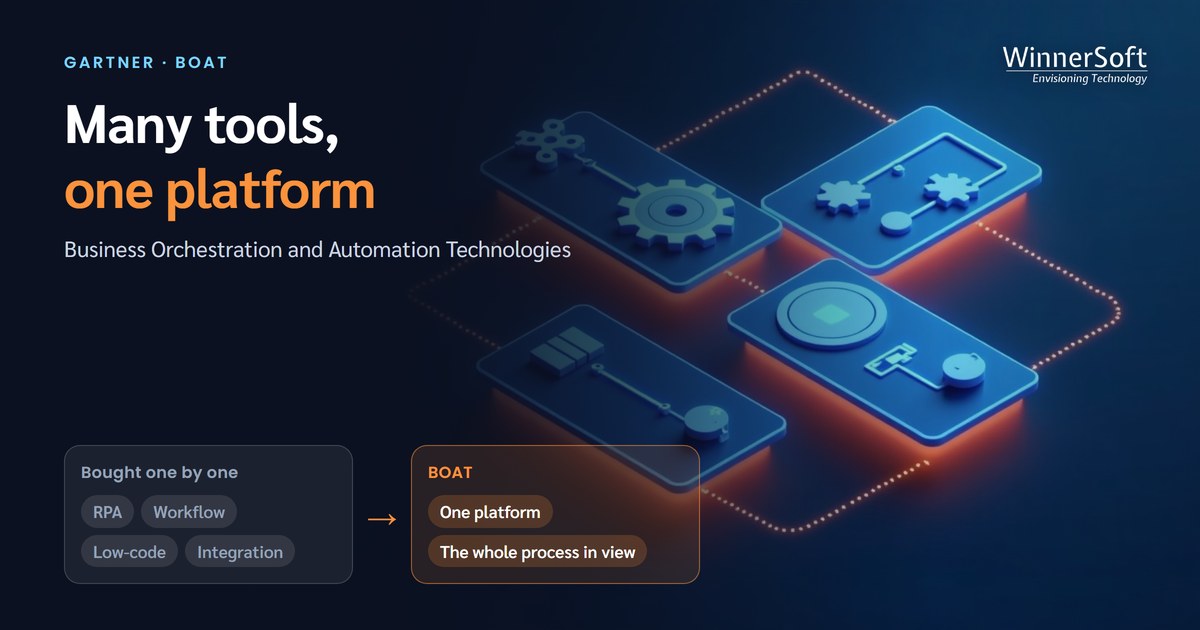
Many organisations bought automation one piece at a time: an RPA tool for data entry, a workflow system for approvals, an integration tool, and now several AI tools. Each piece works. The problem is that none of them sees the whole process.
Gartner has named the idea that addresses this BOAT, and has now published two Magic Quadrant reports on it.
What BOAT means
BOAT stands for Business Orchestration and Automation Technologies. Gartner defines it as a consolidated software platform that delivers enterprise process automation through four capabilities:
- Orchestration of business processes: who does what, after whom, and who is waiting on an approval.
- Enterprise connectivity: moving data between ERP, databases and other systems.
- Low-code development: building forms and apps without writing everything in code.
- Agentic automation: AI that can decide and act on some steps by itself.
If you know Gartner's earlier term Hyperautomation, BOAT is the next step. Hyperautomation was about using many technologies together. BOAT says those technologies belong on one platform.
Why the category exists
A Gartner Quick Answer from 18 September 2025 put it plainly in its title: "Beyond RPA, BPA, and Low Code — The Future Is BOAT". RPA, business process automation and low-code platforms, once assessed separately, are now treated as one market.
The reason shows up in real work. Approving one purchase order means receiving a document, reading it, checking it against the ERP, routing it to an approver and writing the result back. When each step lives in a different tool, the joins between tools are where work stalls and nobody owns it.
Gartner published the first Magic Quadrant for this category on 15 October 2025 and the 2026 edition on 14 September 2026, each assessing around 20 vendors. Gartner also predicts that by 2030, 70% of organisations will move to a consolidated automation platform, up from around 5% today.
BOAT does not mean replacing what you have
This matters more than the category name. Organisations that have already invested in RPA or workflow do not need to tear it out. What changes is the question you ask before the next purchase: not "can this tool do this task?" but "can this tool join the whole process?"
Five questions before your next automation purchase
- When a bot finishes, who knows, and does the next step start by itself or does someone have to click?
- If a process stops halfway, can you see in one place which step it stopped at and who it is waiting for?
- Does the AI you add send data outside the organisation? This matters a great deal in government, finance and healthcare.
- How do incoming paper and PDF documents become data before they enter the process?
- Can one team look after the forms, workflows, bots and integrations, or does every piece need its own specialist?
Where our tools fit
WinnerSoft works with the Nintex Process Platform, which covers every part of the BOAT definition: Nintex K2 for approval orchestration, forms and data connectivity through SmartObjects; Nintex RPA for repetitive screen work; and K2 Intelligence, an AI add-on that runs inside the customer's own network.
What workflow platforms usually lack is the way in: documents that arrive on paper, as PDFs or as photos. That is the job of LuminexDoc, which reads documents with AI and passes the data into the process without building templates.
If you want to find out which piece your process is missing, or where tools overlap, contact us and we will walk through one process with you end to end.
Sources
- Gartner — Magic Quadrant for Business Orchestration and Automation Technologies
- Nintex — Beyond automation: The next era is Agentic Business Orchestration
- Appian — Are Your Automation Tools Hitting a Wall? BOAT Platforms Offer a Way Forward
- UiPath — Recognized as a Leader in the Gartner Magic Quadrant for BOAT (2026)