"The value of Salesforce is not in our UI itself. It's not the application."
That line comes from Patrick Stokes, who runs applications at Salesforce, a company that has sold software through screens for nearly thirty years. He said it on the day Salesforce and Anthropic announced a partnership called Claudeforce.
What Claudeforce is
Salesforce and Anthropic announced Claudeforce on 26 August 2026 as an expanded strategic partnership that puts Claude's reasoning to work on Salesforce's data, workflows, business logic and governance. It runs in both directions:
- Salesforce inside Claude, through a plugin called Salesforce in Claude that ships with 37 prebuilt sales skills such as meeting prep, deal health review and pipeline review. Sellers ask and act from the Claude chat, without opening a Salesforce screen.
- Claude inside Salesforce, as the reasoning model behind Agentforce and the default model in Slack.
Salesforce calls the layer that makes this work AIforce: business data and workflows opened to any AI agent through MCP servers, APIs and CLI tools. Every action is still routed through Salesforce, so business rules and each user's permissions are enforced as before.
At announcement it was open to select pilot customers, and Anthropic released Salesforce in Claude in beta in mid-September 2026 for organisations Salesforce approves.
What actually changes is not the CRM
Salesforce CEO Marc Benioff put it most briefly: "the UI is the AI." The screens people once had to learn, the menus to remember and the forms to fill in become a conversation.
When one of the world's largest enterprise software companies is ready for customers to work without opening its screens, the direction of enterprise software is clear:
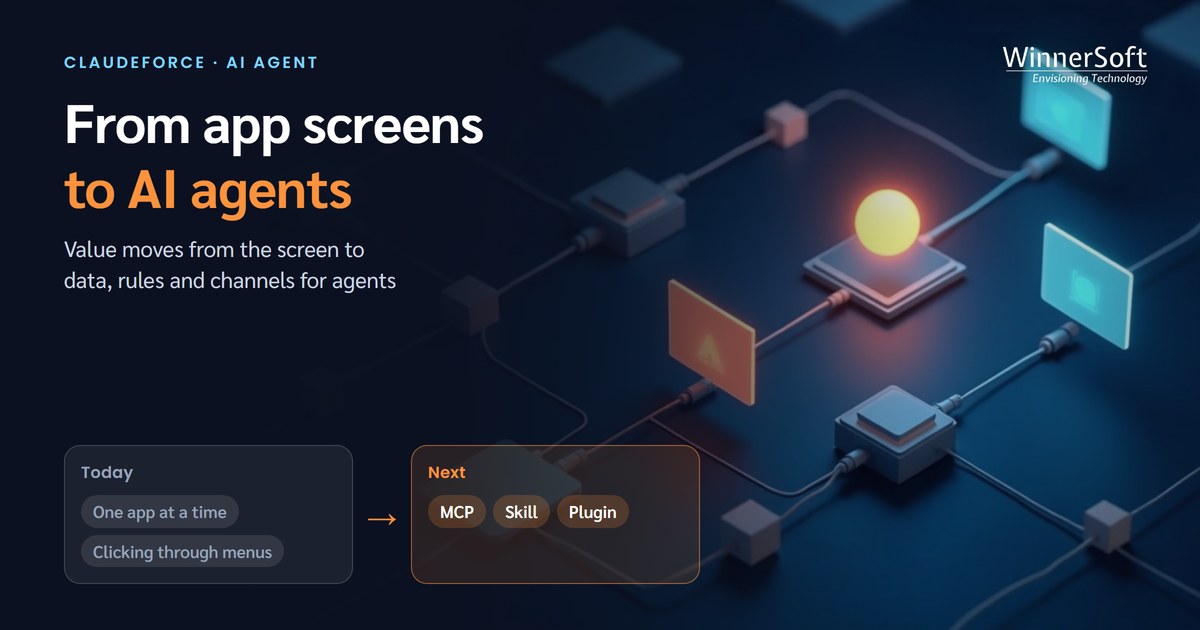
- People will give instructions to AI agents more, and open applications one at a time less.
- Each system's screens will matter less. What matters more is the data, rules and permissions behind them.
- What replaces the traditional application is the channel through which agents work with a system directly: MCP connectors, skills and plugins.
MCP, skills and plugins: the difference
- MCP (Model Context Protocol): an open standard that lets AI agents connect to systems in one consistent way. A system exposes an MCP server once and any agent can use it, much as USB lets devices of any brand plug into a computer.
- Skill: the knowledge of how to do one job properly, such as the steps of a deal health review or how to prepare for a meeting. It turns raw access into work that gets done.
- Plugin: connectors and skills packaged together, installed once and ready to use, like Salesforce in Claude.
The screen goes away; the requirements grow
Read only the headlines and it sounds as if existing systems stop mattering. The opposite is true. Once agents work on people's behalf, the systems behind them must answer questions the screen used to answer for them:
- Whose behalf is this agent acting on, and how much can it see? Salesforce designed it so the agent sees only what that user's permissions allow.
- Which changes need a person to confirm first, and which can go ahead?
- If it gets something wrong, can it be undone, and is there a record of who asked for what, and when?
Screens used to enforce these rules automatically, because people could only press the buttons they were given. Without a screen, the rules have to live in the system itself. That is why Salesforce routes every Claude action through Salesforce instead of letting the AI touch the database directly.
What about systems with no API?
Most organisations run more than Salesforce: older ERPs, systems written in-house a decade ago, and processes that start on paper. These have no MCP server and may never have one.
What works today is building bridges. RPA already works old screens on a person's behalf. A workflow platform such as Nintex K2 is the one place where approval rules and permissions live. Paper documents have to become data before an agent can use them. When those three layers open a channel for agents, older systems can join the new way of working without being torn out.
What we already do
LuminexDoc, our AI document platform, has an MCP connector that lets agents such as Claude check processing status and change configuration in plain language. It follows the same principles as above: the agent proposes a change first, a person confirms before the system acts, and the change can be rolled back.
On Nintex K2, we use AI agents to build workflow systems from a design document, covering the database, SmartObjects, forms and workflow, and the agent tests them itself in the browser. People write the design and review the result.
Start with one question
Go through your core systems one by one and ask: if an AI agent started doing one person's job tomorrow, how would it get into this system? The systems with no answer are the ones to plan for first.
WinnerSoft works across AI agents, workflow, RPA and documents. Contact us to work out which of your systems are ready for agents today, and which need a bridge first.
Sources
- Salesforce — Salesforce and Anthropic Announce Claudeforce (press release, 26 Aug 2026)
- Salesforce — Claudeforce: Salesforce and Claude Partnership
- VentureBeat — Salesforce just put its entire CRM inside Claude
- Salesforce Ben — Salesforce and Anthropic Announce Claudeforce in Q2 '27 Earnings
- PPC Land — Salesforce puts 37 prebuilt sales skills inside Claude