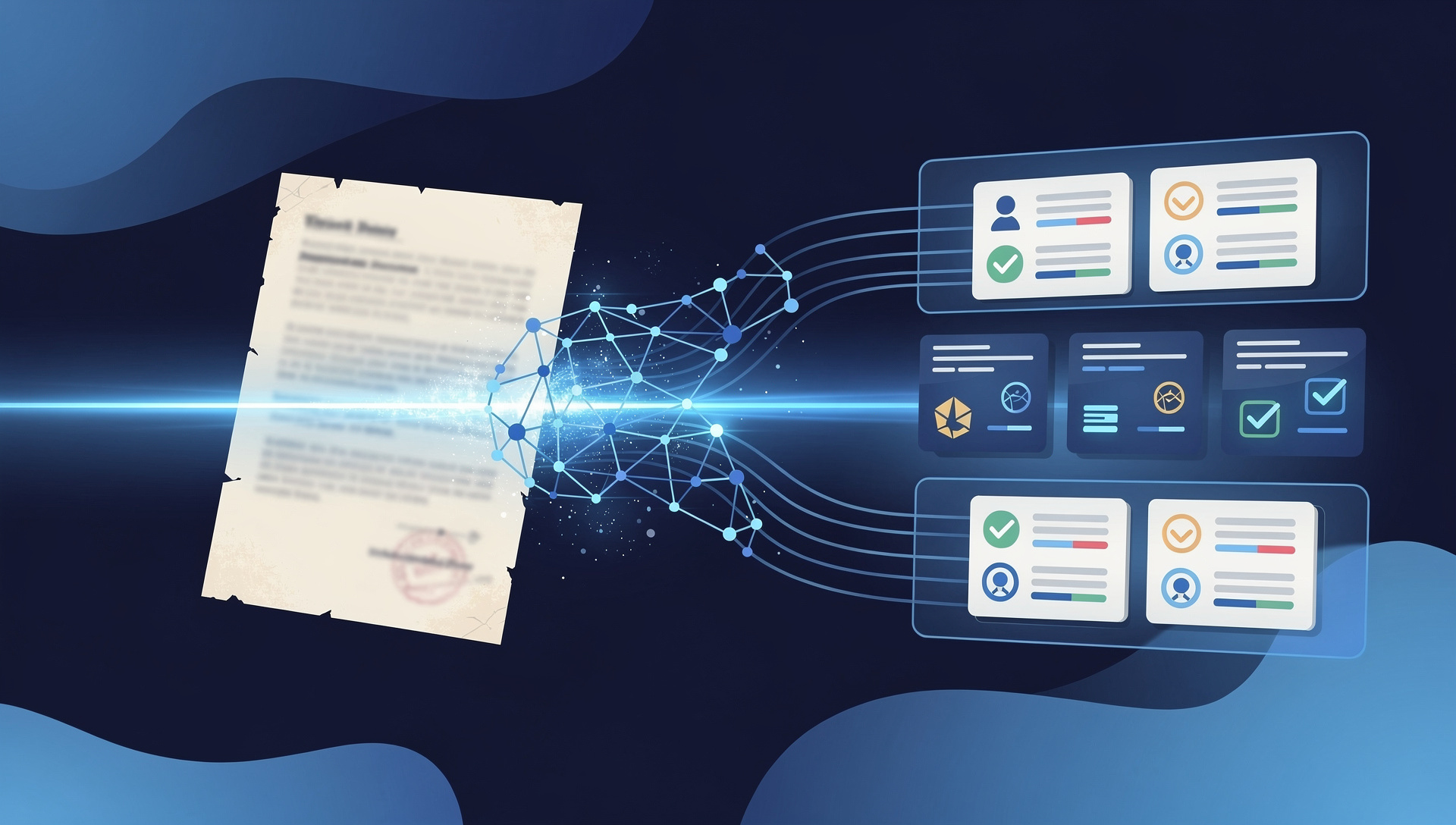
Traditional OCR (Optical Character Recognition) has been reading text off scanned pages for decades — but on its own, it stops at converting an image into characters. AI-powered OCR is the next generation: it keeps OCR's ability to read text, then layers artificial intelligence on top to understand what the document means, validate the data, and feed it straight into business systems. The result is not an incremental improvement — it is a step change. Where plain OCR delivers 70-85% accuracy and a wall of unstructured text, AI-powered OCR delivers 95-98% accuracy and clean, structured, ready-to-use data. For Thai organizations drowning in invoices, contracts, KYC forms, and government filings, this difference is the line between a document process that still needs an army of data-entry staff and one that runs almost on its own.
So what exactly does the 'AI' add, and why does it matter for the documents your organization handles every day? This article breaks down the specific improvements — accuracy, adaptability, language understanding, validation, and end-to-end automation — and shows how a platform like LuminexDoc applies them to real Thai business documents.
1. Dramatically Higher Accuracy on Real-World Documents
Plain OCR performs well on clean, printed, perfectly aligned text — but real business documents are rarely that tidy. They are skewed scans, phone photos, faded thermal receipts, stamps printed over numbers, and handwriting in the margins. On these, traditional OCR accuracy drops sharply, and worse, it returns wrong values silently — confidently reading an '8' where the real digit was a '6'. AI-powered OCR uses machine-learning models trained on millions of real documents to interpret degraded, ambiguous text in context, lifting accuracy into the 95-98% range. Just as importantly, it knows when it is unsure: instead of guessing, it assigns a confidence score and flags low-confidence fields for a quick human check, so errors are caught instead of posted.
2. Understanding Meaning, Not Just Characters
This is the core leap. OCR gives you a stream of characters; AI-powered OCR gives you structured data with meaning attached. Using natural language processing, it recognizes that 'ยอดรวมทั้งสิ้น', 'Grand Total', and 'Total Amount Due' all point to the same field, no matter where they sit on the page or which vendor sent the document. It distinguishes a billing address from a shipping address, links a tax ID to the correct vendor, and identifies that a date is an invoice date rather than a due date. Instead of handing a human a pile of text to interpret, AI-powered OCR delivers labeled, validated fields — vendor, invoice number, line items, VAT, total — ready to use immediately.
3. No More Templates for Every Layout
Traditional OCR extraction depends on rigid templates: you tell the system 'the invoice number lives in this rectangle.' The moment a vendor changes their layout — or a new supplier sends a format you have never seen — the template breaks and processing stalls until someone rebuilds it. AI-powered OCR is template-free. Because it recognizes fields by context and pattern rather than fixed position, it can process a brand-new invoice format correctly on the first try. For a company receiving documents from dozens or hundreds of different sources, this eliminates an entire category of ongoing maintenance work and keeps automation from falling behind a growing vendor list.
4. Genuine Thai Language Understanding
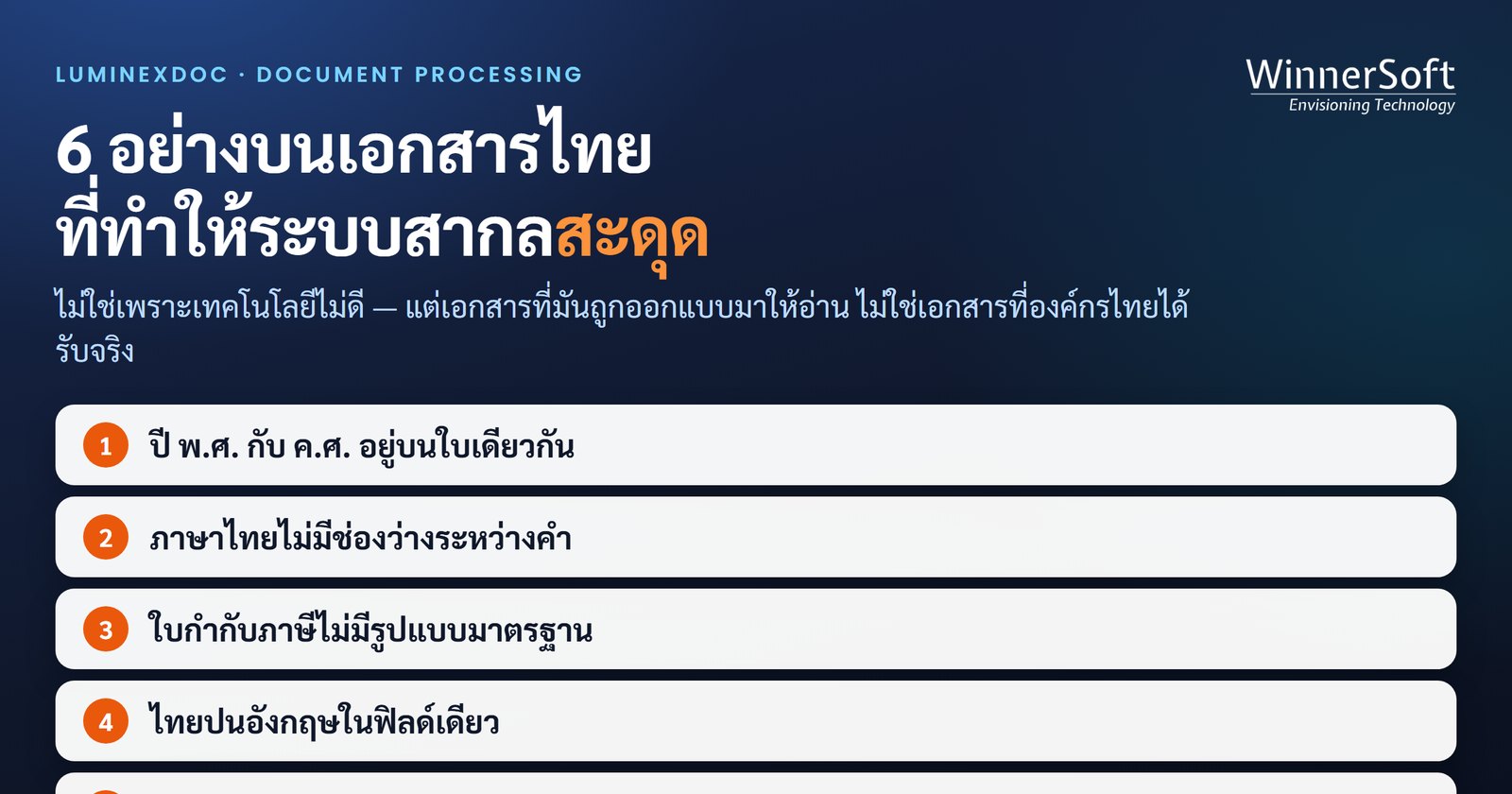
Most global OCR engines were built for Latin scripts and treat Thai as an afterthought. Thai is genuinely hard for machines: there are no spaces between words, vowels and tone marks stack above and below the consonant line, and business documents constantly mix Thai and English within a single line. Basic OCR mangles this. AI-powered OCR trained on Thai understands compound words, parses Thai addresses into province/district/sub-district/postal code, reads Buddhist-era dates (พ.ศ.) and converts them correctly, and handles bilingual documents without losing accuracy. For Thai enterprises, this is the difference between a tool that demos well on English samples and one that actually works on your real paperwork.
5. Built-In Validation and Multi-AI Consensus
A single AI model can still make mistakes. The strongest AI-powered OCR platforms run multiple models on the same document and compare their results — a consensus approach. When all models agree on a value, confidence is high and it is accepted automatically. When they disagree, the discrepancy is flagged for review. This 3-way AI verification dramatically reduces the silent-error problem that plagues traditional OCR. Combined with business-rule checks — does the line-item math add up to the total, is VAT calculated correctly, does the invoice match the purchase order — validation means only genuinely ambiguous cases (typically under 5%) ever reach a human, while the rest flow straight through.
6. End-to-End Automation, Not Just Extraction
The biggest improvement is what happens after the document is read. Plain OCR hands its output back to a person who still has to key the data somewhere. AI-powered OCR closes the loop: validated data is written directly into accounting, ERP, or compliance systems through connectors and APIs, approvals are routed automatically, and the source document is attached for audit. A supplier invoice can arrive by email and appear as a matched, posted entry in your ledger minutes later, with humans involved only for exceptions. This is what turns document processing from a cost center staffed by data-entry teams into an automated pipeline that scales with volume instead of headcount.
The Measurable Payoff
- Speed: Processing time per document drops from 15-20 minutes of manual handling to under 30 seconds of mostly automated flow.
- Accuracy: From 70-85% with plain OCR to 95-98% with AI-powered OCR — and climbing toward 99% as the system learns from corrections.
- Lower error cost: Validated extraction eliminates the costly mistakes — transposed digits, wrong vendor, miskeyed tax amounts — that plain OCR passes through silently.
- Less manual labor: Staff move from repetitive keying to exception handling and analysis, and the team no longer grows linearly with document volume.
- Faster close and better compliance: A complete, auditable trail of every extraction and correction speeds up month-end close and supports PDPA requirements.
Plain OCR reads your documents. AI-powered OCR understands them, checks its own work, and finishes the job — turning images into trusted data without a human in the loop for most of it.
How LuminexDoc Applies AI-Powered OCR
LuminexDoc by WinnerSoft is built around exactly this approach. It uses OCR as the character-reading layer, then applies AI to understand each document, extract the fields you need without per-vendor templates, and validate them through a 3-way AI consensus check that flags only genuinely uncertain values. It is purpose-built for Thai enterprises — with native Thai language understanding, Buddhist-era date handling, bilingual document support, and flexible deployment including on-premises for organizations with strict data-residency rules. And it integrates directly with accounting and ERP systems so the data does not just get read — it gets used. To see the improvement on your own documents rather than a generic benchmark, visit our LuminexDoc page at /luminexdoc or contact our team at /contact for a free document processing assessment.