Thai official correspondence — หนังสือราชการ — looks like the easiest document in the organisation to automate. Its structure is set by the government's records regulation: a document number, the issuing agency, a date, the subject line, the addressee, references, enclosures, the body, then a signature and title. Every letter carries the same parts in the same order.
That sameness is exactly what makes organisations underestimate the job. They buy template-based OCR, and then discover it reads letters from one agency and fails completely on the next.
The same parts, never in the same place
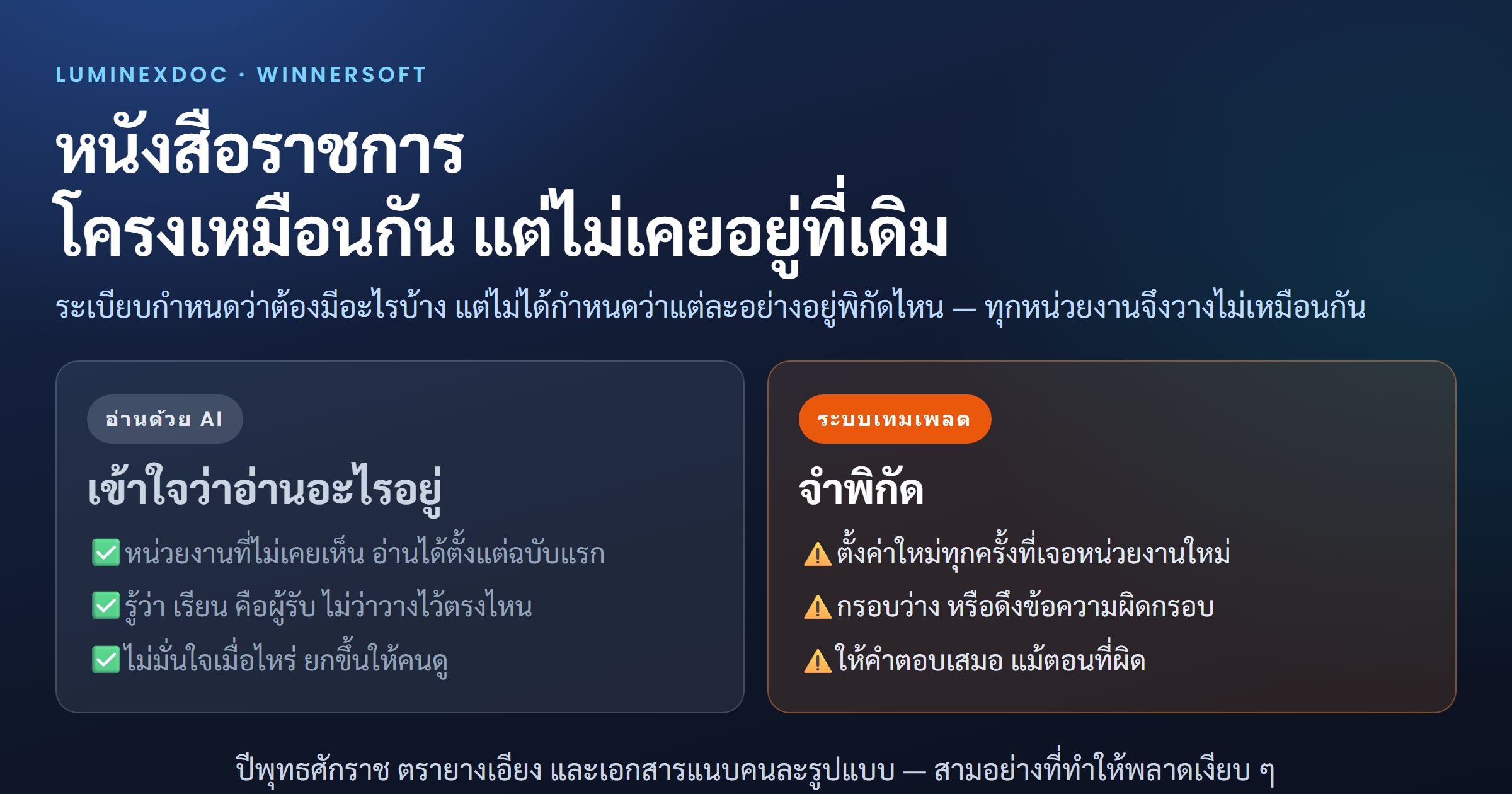
The regulation says what an official letter must contain. It does not say where on the page each part has to sit. So every agency — and sometimes every division inside one agency — places them differently, with different header block widths, different margins, a large Garuda emblem on some and an additional agency logo on others.
A template system works by remembering coordinates. You tell it "the document number is in this box". When the next letter arrives from a different agency, that box is empty — or worse, it contains something else, and the system extracts the wrong text with nothing to indicate it was wrong.
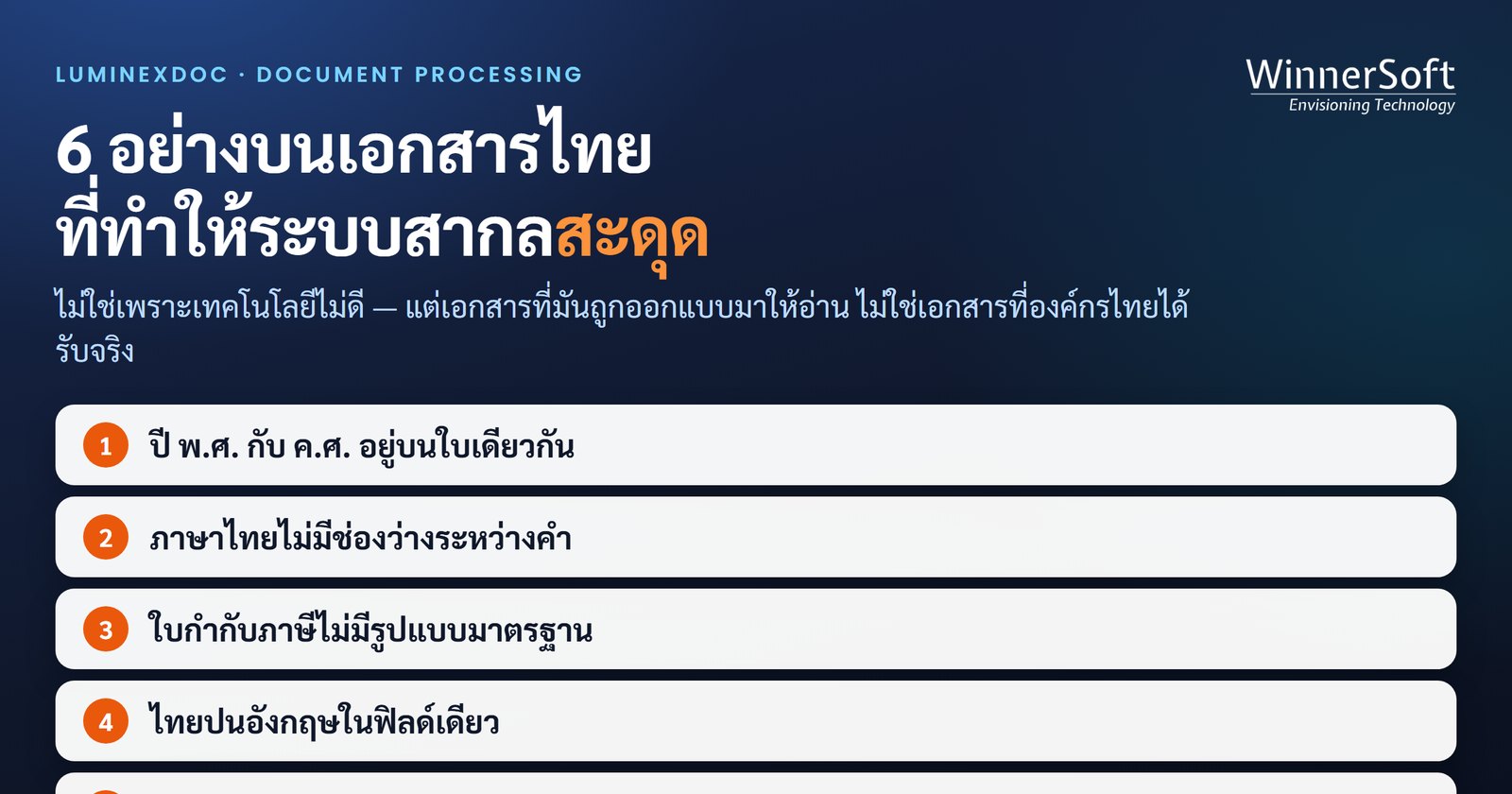
Six things that make Thai official documents harder than invoices
- Document numbers follow no common format. Each agency has its own code, of varying length, mixing letters, digits, dots and slashes, with ว prefixing the number on circulars.
- Dates are in the Buddhist era and often written out in words rather than digits. A system expecting a Gregorian year will read the year wrong by 543 and say nothing about it.
- เรื่อง, เรียน, อ้างถึง and สิ่งที่ส่งมาด้วย vary in length from letter to letter. References may list several items or be absent entirely, which shifts everything below them.
- The Garuda emblem, signatures and received-date stamps frequently overlap the text — especially the stamp, which is applied afterwards and rarely straight.
- Enclosures usually run to several pages in a completely different format from the covering letter: tables, forms, or copies rescanned until they are faint.
- Official Thai uses long subordinated sentences, and the operative phrase — the request, or the deadline — tends to sit at the end of a paragraph rather than the start.
The damage is not the misreading. It is that nobody knows about it
A document number read with one character wrong is recoverable if somebody sees it. The problem is that most template systems always return an answer. They have no state for "not sure", so a wrong value flows into the records system looking exactly like a right one, and surfaces later when a file cannot be traced.
Which is why, when evaluating a document reader, the most informative question is not what accuracy it claims. It is what the system does at the moment it is not confident.
How AI reading differs from a template
A system built on language models does not memorise coordinates. It understands that what it is reading is an official letter, and that in an official letter the document number sits near the issuing agency's name and เรียน identifies the recipient — wherever on the page they happen to be printed. A letter from an agency it has never seen is readable on the first try, with no new template to build.
In LuminexDoc every field is read by three separate AI models that cannot see each other's answers. Where all three agree, the field passes. Where they disagree, that field is raised for a person to look at. Nobody checks every letter; they check the places the system itself flagged.
Five questions worth asking a vendor first
- For a letter from an agency the system has never seen, what has to be configured, and how long does it take?
- What is the Buddhist-era year converted to before it reaches the destination system, and who defines that rule?
- When the system is unsure about one field, does it stop, ask a person, or guess and pass it on?
- With multi-page enclosures in a different format from the covering letter, can the system tell which one is the covering letter?
- Once a misread value has reached the records system, is there a trail back to the original image?
Where to start
Do not start with the whole records system. Take the single type of letter that arrives most often — in many organisations that is circulars or approval requests — and measure two things: the time a person spends on one today, and how many arrive per month. Those two numbers decide whether any of this is worth doing, before a baht is spent.
If you want to test it against your own documents, we start from a sample set and measure on your documents rather than on a demonstration set.